SBSWEET / LAB
 SBSWEET / LAB
PROJECT CARVING 180 · ARTICLE 05
Project Carving 180 chapter 05 — The difference isn’t the muscles · It’s how they work
After the last chapter, one question naturally follows. If carving places different demands on the body... does it require different muscles? The answer is surprisingly simple. No. A carving rider doesn't have different muscles. We all have the same anatomy. The difference is how those muscles are asked…
After the last chapter, one question naturally follows.
If carving places different demands on the body...
does it require different muscles?
The answer is surprisingly simple.
No.
A carving rider doesn't have different muscles.
We all have the same anatomy.
The difference is how those muscles are asked to work.
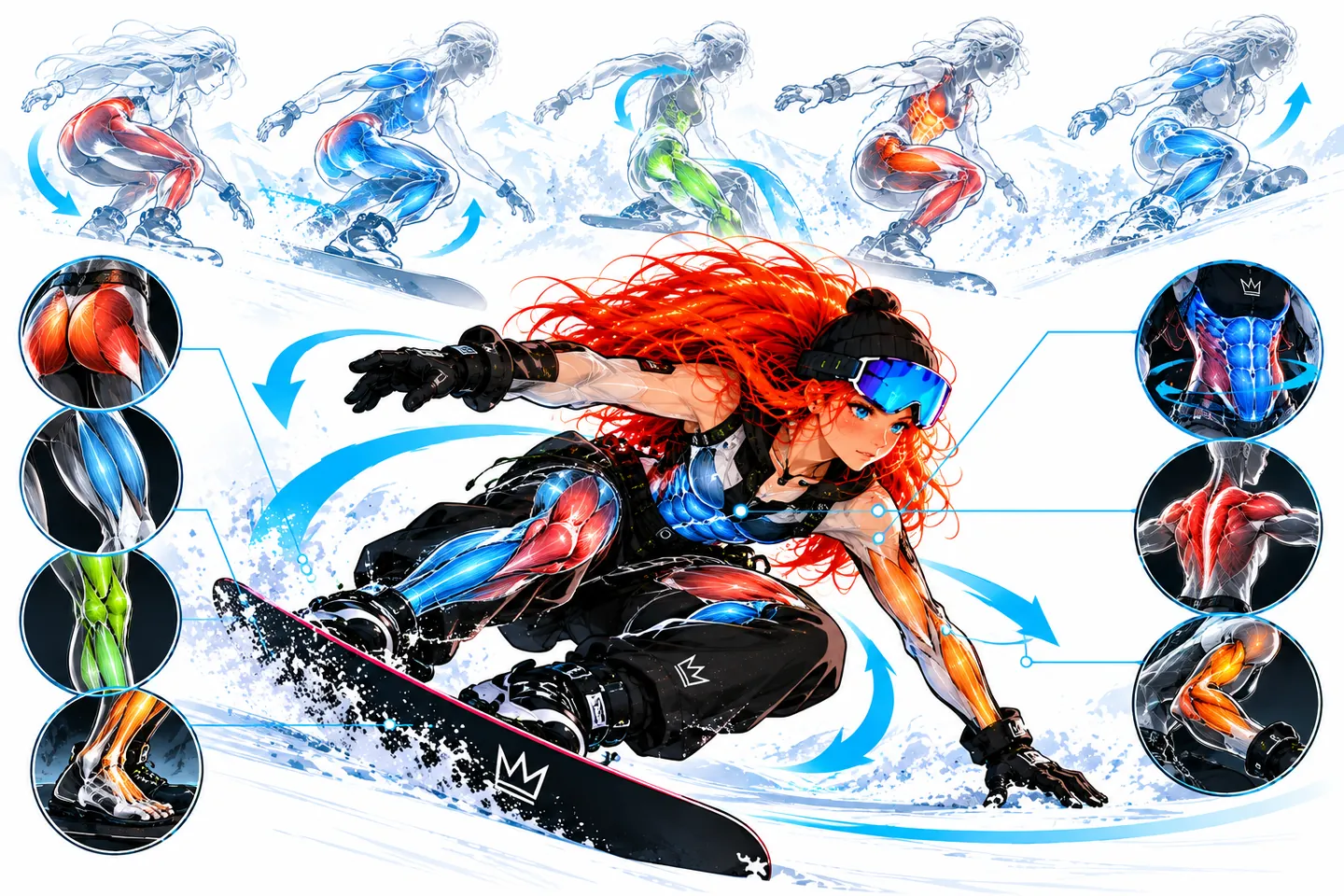
During a carving turn, your muscles don't perform one job.
They constantly change roles.
One moment they're producing force.
The next, they're absorbing it.
Then they're holding the body in a stable position.
A fraction of a second later, they're releasing that force and redirecting it into the next turn.
The muscles don't change.
Their function does.
That's why, when I analyze carving, I don't think in terms of body parts.
I think in terms of physical qualities.
A carving rider needs:
- Eccentric strength — to absorb and control force.
- Isometric strength — to maintain stability under load.
- Explosive strength — to create pressure quickly.
- Reactive strength — to adapt instantly as conditions change.
- Lateral stability — to keep the entire kinetic chain aligned:
HIP → KNEE → ANKLE.
One of the most important examples is the core.
During a carving turn, the core doesn't simply stabilize the body.
It resists, transfers and redistributes the forces generated by the snowboard through the entire kinetic chain.
That's why core training for carving isn't just about getting stronger.
It's about learning to control force.
None of these qualities is more important than the others.
They're all working together.
Remove one...
and the movement becomes less efficient.
Not because you're weak.
But because your body isn't prepared for what the movement demands.
That's why I've stopped asking,
"Which muscles should I train?"
Instead, I ask,
"Which physical quality does this movement require?"
Because once you answer that question...
training becomes much more intentional.
Stop asking which muscles to train.
Start asking what the movement demands.