SBSWEET / LAB
 SBSWEET / LAB
SBSWEET LAB · TRAINING NOTES
Balance Board — More Than Balance
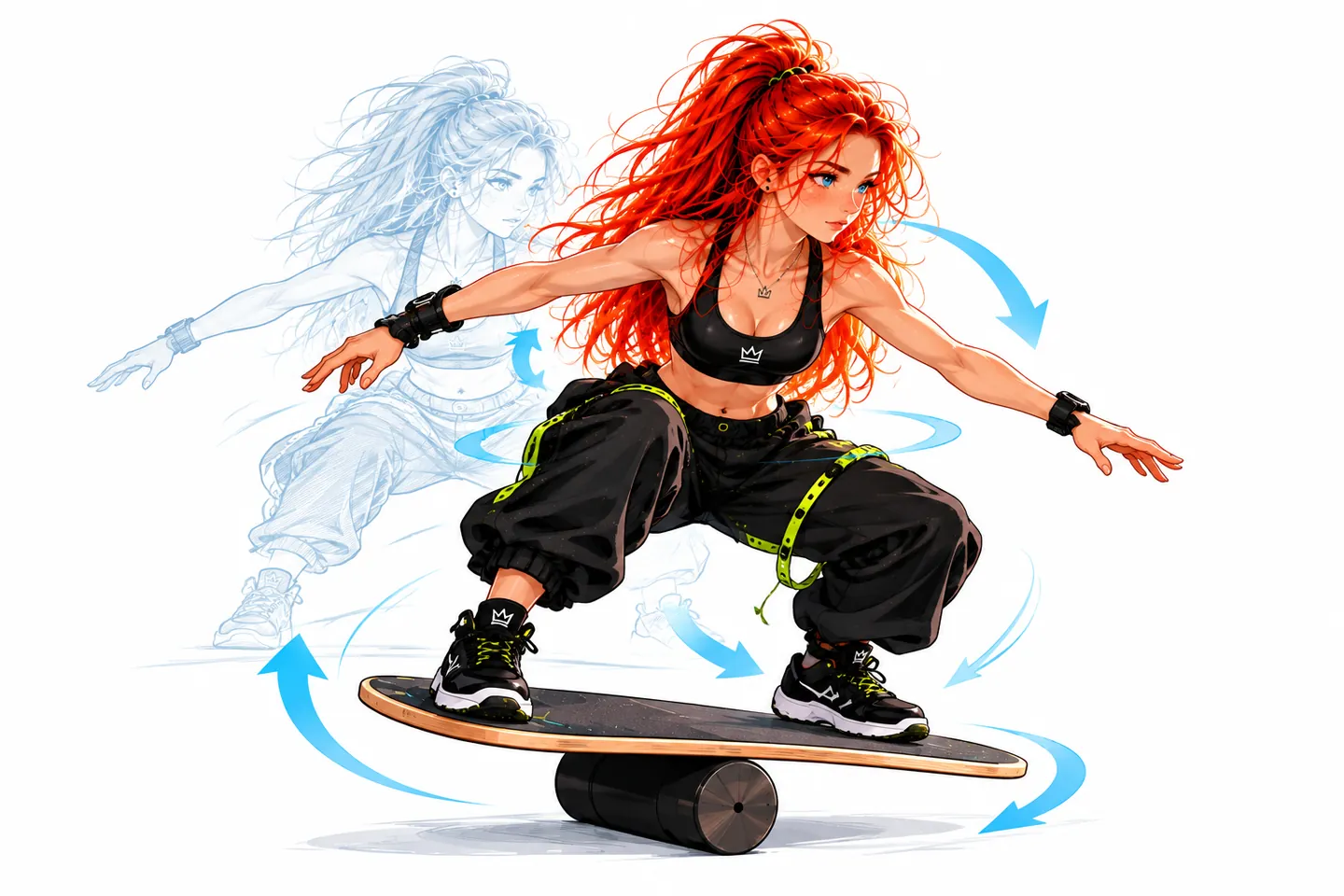
A balance board looks simple. Stand on it. Don't fall. But for a snowboarder, that's not really what we're training. Balance isn't a position. It's a continuous process of detecting change and responding to it. Your nervous system constantly receives information from: Vision — where you are relative…
A balance board looks simple.
Stand on it.
Don't fall.
But for a snowboarder, that's not really what we're training.
Balance isn't a position. It's a continuous process of detecting change and responding to it.
Your nervous system constantly receives information from:
Vision — where you are relative to the environment.
Vestibular system — how your head is moving and oriented in space.
Proprioception — what your joints, muscles and body are doing.
The brain combines this information and creates a response:
Adjust the ankle.
Stabilize the knee.
Move the hip.
Control the trunk.
Shift pressure.
Recover the position.
And do it again.
That's why balance-board training can be useful for snowboarders.
It challenges our ability to:
Maintain postural control
Stay organized while the support beneath us is unstable.
Detect pressure changes
Feel small shifts before they require large corrections.
React quickly
Respond to unexpected movement.
Coordinate the kinetic chain
Connect feet, ankles, knees, hips and trunk.
Develop proprioception
Understand body position without constantly relying on vision.
And that's important because snowboarding never happens in a perfectly stable environment.
Speed changes.
Pressure changes.
The board bends.
Terrain changes.
Snow changes.
Forces change throughout the turn.
The body has to keep adapting.
So balance training shouldn't end with:
“Can I stay on the board for 60 seconds?”
Once that becomes easy, change the task.
Change your stance.
Add controlled movement.
Add rotation.
Reduce visual dependence.
Introduce reaction tasks or unpredictable stimuli.
The goal isn't simply to make balance harder.
It's to make adaptation better.
But a balance board is not snowboarding.
It doesn't reproduce speed, edge interaction, terrain or the forces of a real turn.
And it doesn't teach carving technique.
It's a training tool.
One piece of preparation that can support:
Balance. Proprioception. Postural control. Reaction. Coordination. Pressure awareness. Adaptability.
Snow teaches us how to use those qualities on a snowboard.
Don't train to master the balance board.
Use the balance board to build a body that adapts.