SBSWEET / LAB
 SBSWEET / LAB
PROJECT CARVING 180 · ARTICLE 14
Project Carving 180 chapter 14 — One Foundation · Different movements
Whenever we talk about different carving styles, there's an obvious argument: "But the fundamentals are the same." And I agree. The foundation of carving is the same. But a foundation isn't the whole structure. Think of it as a pyramid. At the bottom are the fundamentals — the…
Whenever we talk about different carving styles, there's an obvious argument:
"But the fundamentals are the same."
And I agree.
The foundation of carving is the same.
But a foundation isn't the whole structure.
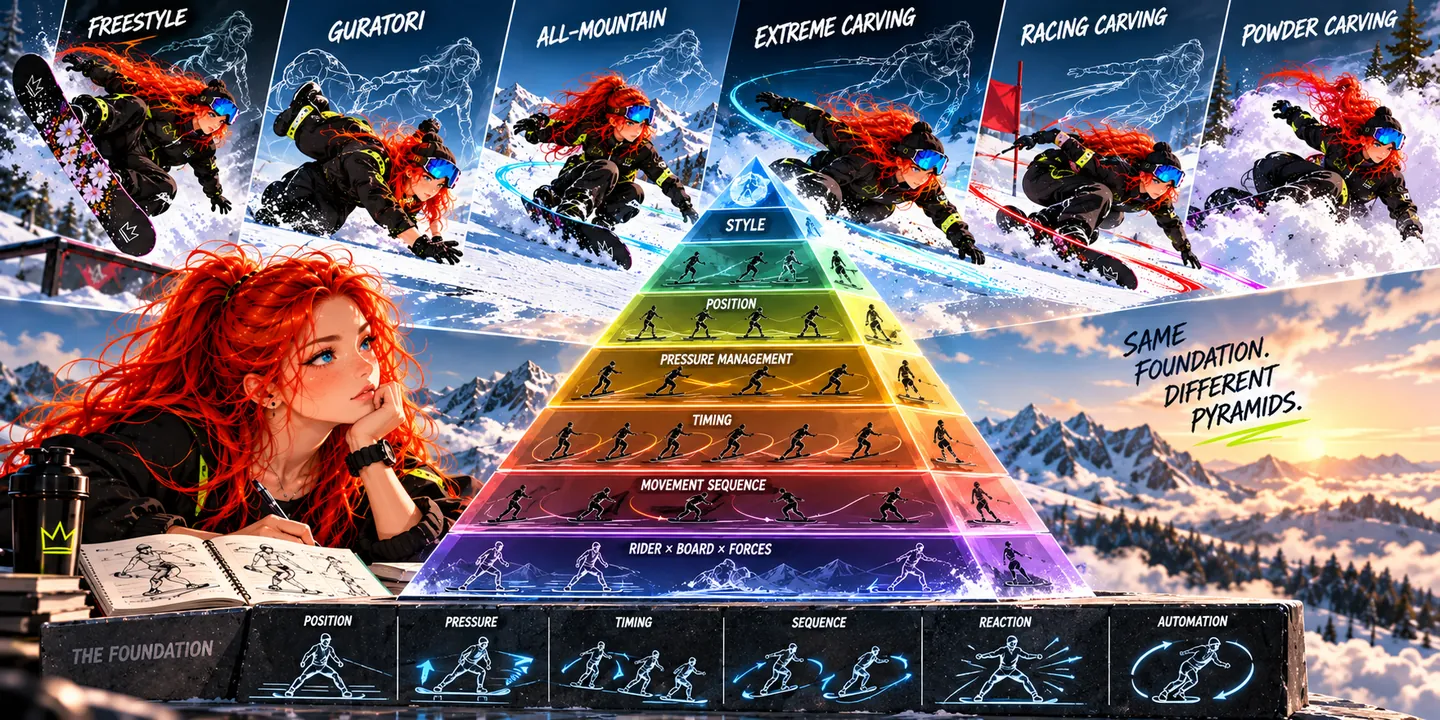
Think of it as a pyramid.
At the bottom are the fundamentals — the principles that make carving possible.
Then we build on top of them:
Different positions.
Different ways of managing pressure.
Different timing.
Different movement sequences.
Different relationships between the rider, the board, and the forces acting through the turn.
The foundation stays the same.
The pyramid we build on top of it doesn't.
And that's where carving styles begin to separate.
Which leads to a much more interesting question:
Can a highly skilled rider from one carving style precisely reproduce what a highly skilled rider from another style is doing?
Not simply draw a similar turn.
But reproduce the movement itself.
For some riders, the answer is yes and we know why.
For others, no.
And the difference isn't necessarily the riding level.
Before you can reproduce another rider's movement, you first have to understand what they're actually doing.
See the position.
Recognize how pressure is created and released.
Understand the timing.
See the sequence.
And only then can you ask your own body to reproduce it.
You can't reproduce a movement you don't understand.
That's where X60 becomes style-specific.
The foundation remains:
Position. Pressure. Timing. Sequence. Reaction. Automation.
But how those elements are organized depends on what we're preparing the rider to do.
So preparation shouldn't begin by copying drills.
It should begin by understanding the movement:
What exactly does this style ask the rider to do?
Then we build the preparation around that answer.
The foundation can be universal.
The application cannot.
One foundation.
Different pyramids.
Different movement.
Different preparation.
Because the real question isn't whether all carving shares the same fundamentals.
Of course it does.
The real question is:
What are you building on top of them?